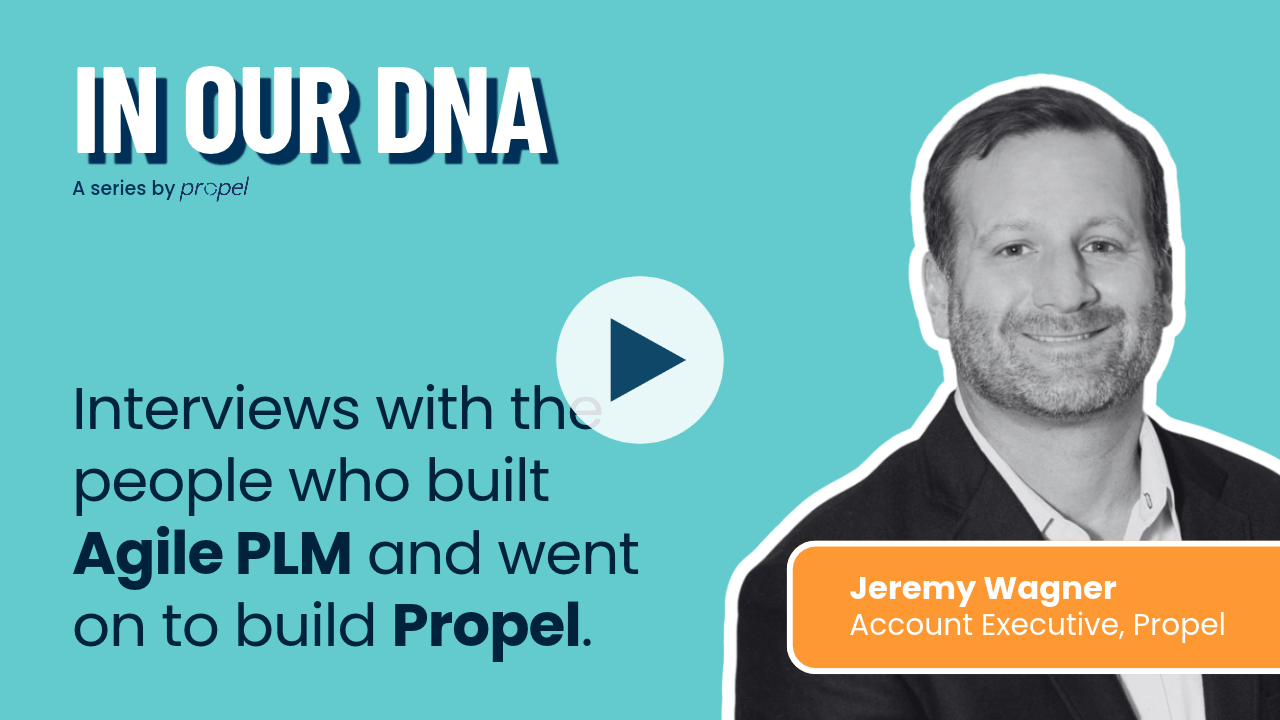
Webinar Playback ▶▶▶

Outgrowing Agile PLM: Why Teams Move to Propel | In Our DNA Series

2+ Weeks

per FDA audit of paper-based quality records before PLM automated CAPA

Natural Successor

to Agile, Propel offers ECO redlines and BOM structure with a modern twist

AI + MCP

let teams ask connected systems questions and free up time for the work that matters

Quick Overview

Hear why Agile PLM users are outgrowing Agile and moving to Propel in this "In Our DNA" session, an original series by Propel. The session explains why Propel feels familiar to Agile users, with proven ECO redlines, BOM structure, change management, and CAPA, and then adds extensible cloud architecture, easily modified processes, native agentic AI, and Model Context Protocol (MCP). Jeremy Wagner, a Propel Account Executive with approximately seven years in the Agile ecosystem, recalls FDA audits of paper-based records taking two weeks or longer before CAPA was automated in PLM.

Key Takeaways

Agile PLM won users by replacing paper and SharePoint with one system for BOMs and changes
Many teams arrived at Agile PLM from manila-envelope "e-folders" or SharePoint. Agile gave them BOM, variant, change, stage-gate, and CAPA management in one system, with configuration simple enough to avoid hiring an army of people.
Agile users find Propel familiar because ECO redlines and BOM structure carry over
Propel is an evolution of what worked in Agile, so ECO redlines and BOM structure read as Agile-esque from day one. The whole product team participates, rather than only CAD and PDM users. That continuity shortens the learning curve for long-time Agile teams.
Propel adds AI and MCP to Agile-style PLM so teams can query systems and reclaim time
Connecting systems through Model Context Protocol (MCP) lets users ask questions across them and free up team time. Quality teams push more CAPAs through, and efficiency gains compound from there. The session sees limitless upside.
Quality teams can fail faster to catch problems before products ship
AI and MCP free quality teams to push more CAPAs through and surface the ones that will fail early. Failing faster means catching a problem before the product goes out, which is the point of automating quality workflows.
Propel processes can be modified after a Kaizen event to match how work actually happens
Teams can add or remove steps in CAPA, NC, and change order processes, including tiered change order levels, when a step lags or fails to improve results. Propel builds on established PLM processes rather than reinventing them.
A modern cloud platform gives Agile customers performance and uptime they now expect
Cloud-based architecture keeps performance steady and the system from going down, which is what customers see after moving. The session frames the move as outgrowing Agile, and credits Agile for the foundation Propel builds on.
Learn More
Read the Life After Agile guidebook for Agile PLM customers to see why Propel is the natural successor to Agile PLM, how low-risk migration works, and what benefits customers realize after moving.
learn more