Product Requirements Management

Connect every user need, functional requirement, and test plan record to your BOM so teams trace, reuse, verify, and ship with full confidence.
Get the demo
Traceability Turns Requirements Into Defensible Design Decisions
What is Product Requirements Management?
Product requirements management is the discipline of capturing, structuring, and connecting user needs, functional requirements, design outputs, and verification records across a product's full development lifecycle. Propel’s Requirement solution provides the operational backbone that links customer intent to commercial reality, and the evidentiary foundation that makes design controls compliance achievable.
Full BOM Traceability
Connecting every user need to a live BOM gives teams instant visibility into how requirements flow through design, testing, and production.
Acceleration With Reuse
Requirements validated for one product become a reusable asset across the portfolio, accelerating every subsequent development cycle and reducing inconsistency.
Audit-Ready Records
When traceability data lives on a unified product thread, every requirement, design output, and V&V record is searchable in seconds and always current.

Propel Connects Requirements to Every Stage of Development

Unified Trace Matrix
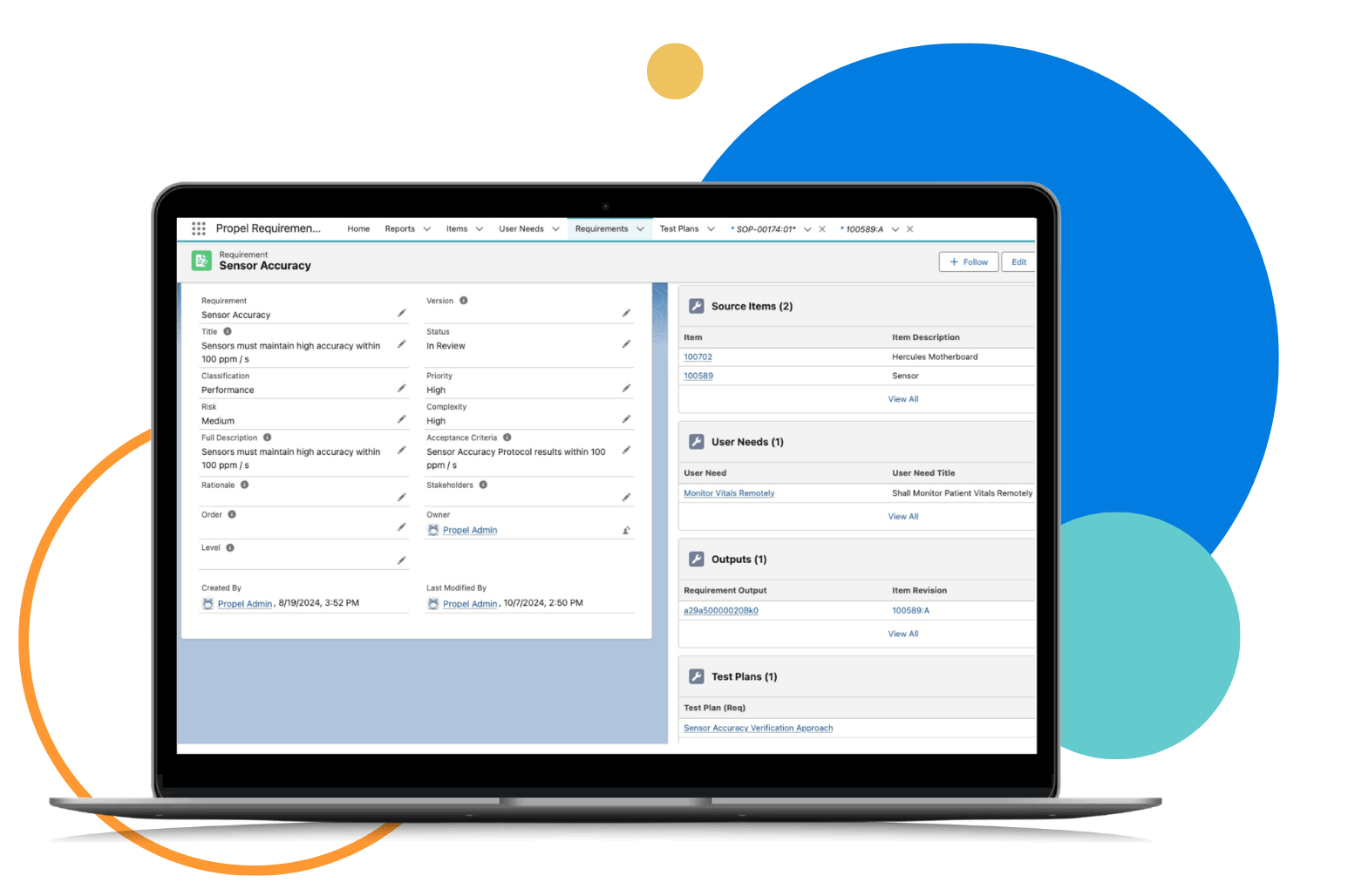
Propel's built-in Trace Matrix lets every Assembly, Item, and Component carry its own user needs, functional requirements, design outputs, and V&V test plans—then automatically rolls them up into one view. A complete traceability view across the entire product portfolio is generated at the click of a button, giving teams focused on their own subassemblies the bigger picture regulators demand, ready for design reviews, audits, and submissions.
Requirement Reusability
Propel lets teams reuse user needs and requirements across products and product lines, so engineers build on proven foundations rather than reconstructing requirements for every new product. Reusing validated requirements compresses development cycles and reduces the risk of inconsistency across a growing portfolio.
AI-Powered Change Impact
When a Change Order touches a requirement-linked item, Propel One's agentic AI looks through all affected items, changes, and documentation to surface a holistic picture of downstream impact, flagging risks for engineering and quality teams before they become bottlenecks.
learn more
See Propel's unified platform in action
You already have the product data. See what becomes possible when it's all connected.
Take product tour
More Capabilities
Requirements Roll Up With BOM
Propel lets teams establish user needs and requirements at the subassembly level as they build, and your product's Trace Matrix naturally incorporates them as the BOM comes together. A cross-functional product draws requirements from many teams and subassemblies; Propel lets each team focus on their piece while keeping the bigger picture automatically up to date as design changes happen.
Direct BOM Linkage
Propel connects requirements to items at every level of the bill of materials. Teams can inspect related user needs, design outputs, and V&V test plans from a pop-up window directly on the item record, keeping context close to the work.
Built-In Trace Matrix
Propel generates and stores a complete traceability matrix covering items, user needs, product requirements, design outputs, and V&V test plans. The matrix is produced on demand and always current, eliminating manual assembly for design reviews and regulatory audits.
Cross-Functional Collaboration
Quality, engineering, sales, marketing, and suppliers collaborate on requirements within a single unified product thread. Every stakeholder works from the same data at every stage of the product lifecycle, reducing version conflicts and miscommunication.
Design Controls Audit Trail
Every step of the requirements process is captured in a complete audit trail. Propel's cloud-native platform supports full design controls compliance, giving regulated manufacturers the control and traceability they need from first concept through commercial launch.
Concept To Customer Solutions for Fast-Moving Product Companies
Propel PLM
Cloud-native, role-based, and easy-to-use product lifecycle management enables enterprise-wide collaboration so teams work smarter, faster, and better together.
how it works
Propel QMS
Complete quality management system that unifies part, process, and supplier quality to deliver safer products, higher customer satisfaction, and increased profits.
how it works
Propel One
Natively integrated agentic AI automates workflows, surfaces insights, and accelerates every team across PLM, QMS, and PIM from concept to customer.
how it works
Surmodics Cut Change Process Time From 278 Days to 73 Days
View All Customer Stories
Design controls, accelerated
Surmodics, a medical technology company, used Propel to accelerate change impact assessments by 73%, compressing their quality management change process from an average of 278 days to 73 days. Faster requirement-linked change reviews meant fewer bottlenecks between engineering and commercial launch.
see their story
View All Customer Stories
FAQ
How does Propel connect product requirements to the bill of materials?
Propel links requirements directly to items at any level of the BOM, so teams can trace user needs from initial capture through design outputs and V&V test plans. A built-in Trace Matrix generates this full traceability view on demand, eliminating the manual work typically required to compile audit or review documentation.
Can requirements be reused across different products in Propel?
Yes. Propel is built for requirement reusability, allowing teams to apply validated user needs and functional requirements across multiple products and product lines. This eliminates the inefficiency of recreating requirements for every new development effort and helps manufacturers maintain consistency across a growing portfolio.
How does Propel support design controls compliance for regulated industries?
Every action taken within Propel's requirements process is captured in an audit trail, providing the full traceability and documentation control that design controls regulations require.