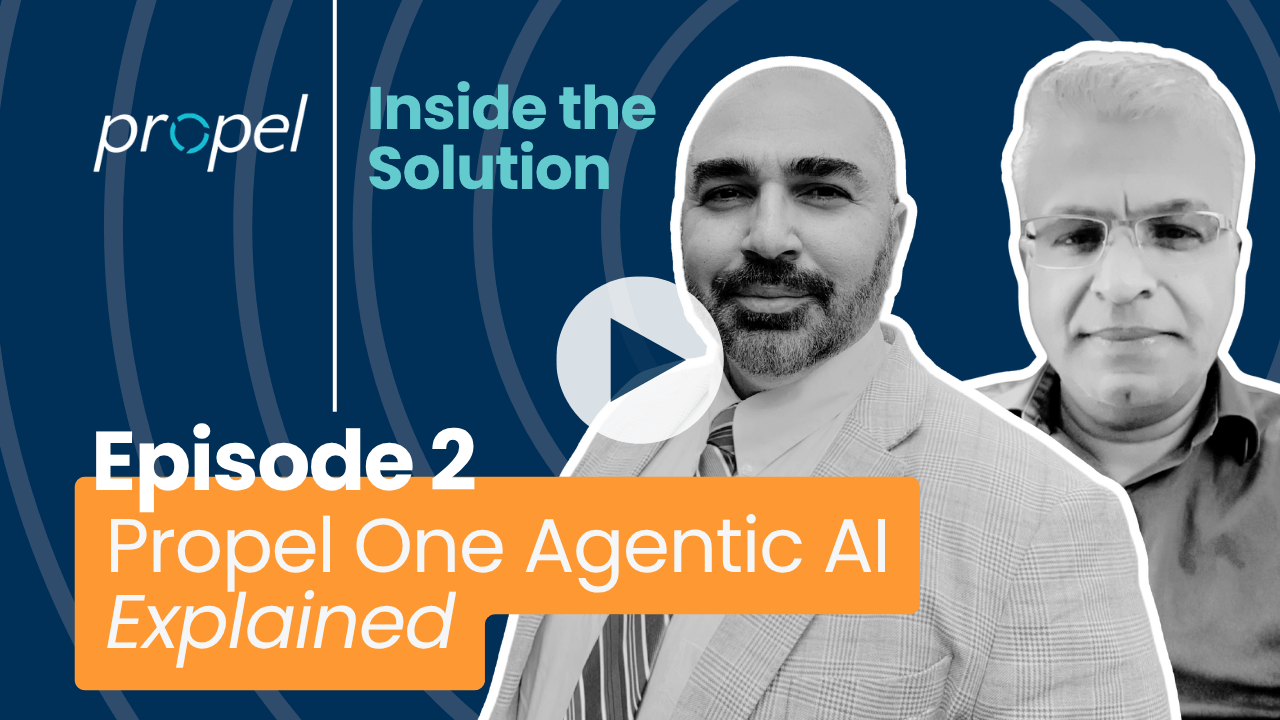
Webinar Playback ▶▶▶

What Makes Propel One's Agentic AI Different

15% by 2028

of enterprise workloads will be automated by agentic AI, per Gartner's prediction

Zero-copy

LLM policy ensures customer IP is never used to train outside AI models

4 pillars

define Propel One: integral, data, security, and availability

Quick Overview

Get the inside story on Propel One's agentic AI architecture in this Propel webinar featuring Steve Toukmaji and Chandra Subramanian. The session explains why Propel One is built natively on Salesforce Agentforce rather than bolted on with APIs, giving agents direct access to Propel's unified product thread across PLM, QMS, and PIM. Speakers note Gartner predicts 15% of enterprise workloads will be automated by agentic AI by 2028, and detail how Propel One enforces role-based permissions, zero data retention, and full audit trails so manufacturers in regulated industries can innovate without sacrificing compliance.

Key Takeaways

Propel One embeds AI directly into the platform instead of bolting it on.
Propel One is built natively on Salesforce Agentforce rather than connected via third-party APIs, so AI agents inherit the same data model, workflows, and security as the core platform.
A unified product data model grounds AI in real context.
Because Propel already unifies PLM, QMS, and PIM data, Propel One's agents reason against accurate bills of materials, revisions, and change orders instead of guessing from fragmented systems.
Agentic AI goes beyond prediction and summaries to take action.
Predictive AI forecasts outcomes and generative AI drafts summaries, but agentic AI detects issues, keeps humans in the loop, and executes approved tasks like updating records and routing approvals.
Role-based permissions carry through every AI interaction.
Propel One inherits each user's existing permission set down to the field level, so a VP of engineering and a product manager get different, correctly scoped answers from the same agent.
Zero-copy LLM policies keep customer IP out of training data.
Propel One operates through the Agentforce Trust Layer, which commits that LLM providers will not copy or train on customer data, and logs an auditable trail of every prompt and response.
Engineers and quality teams can save hours on routine research.
Agents summarize item revisions, flag single-source part risks, and condense lengthy declarations and manuals, cutting tasks that once took 20 to 30 minutes down to a quick, grounded answer.
Propel One requires no separate AI infrastructure to deploy.
Because agentic AI runs inside the existing Salesforce and Propel platform, implementation uses the flows and actions customers already have, with prebuilt prompt templates ready to configure.
Learn More
Go deeper on the five non-negotiable architecture requirements agentic AI needs, from reasoning engines to unified data, and see exactly why Propel One meets every one while bolt-on legacy PLM AI tools fall short.
learn more